
Table of Contents
- Embracing AI Integration
- Implementing Zero Trust Security
- Adopting Scalable and Flexible Technologies
- Enhancing Data-Driven Workforce Planning
- Leveraging Proactive Managed Services
- Strengthening Cybersecurity Frameworks
- Supporting Hybrid and Remote Work Environments
- Final Thoughts
Adapting to rapid technological advancement is no longer an aspiration but a necessity for organizations in every sector. The proliferation of new digital tools, shifting workforce models, and the escalating threat landscape require forward-thinking strategies to safeguard long-term business viability. Successful IT management now demands anticipating change and embracing innovation. Leveraging insights from a banking expert can offer additional depth on how industries must transform their IT practices to remain resilient.
Resilient IT management is not about one-off investments in new technology. Rather, it is about establishing adaptable systems, robust security protocols, and data-driven frameworks to support lasting growth and operational excellence. By understanding the impact of emerging trends and integrating proven methodologies, organizations can create IT ecosystems that foster sustainable success and agility amid uncertainty.
Embracing AI Integration
AI is redefining IT operations by empowering companies to shift from traditional reactive models to predictive, automated approaches. Leveraging machine learning for analytics, system monitoring, and customer service can drive substantial efficiency gains while improving accuracy in decision-making. For example, integrating AI-powered virtual agents for IT support can handle routine inquiries and triage complex tickets, reducing the volume of manual requests and freeing up IT staff for high-impact initiatives.
Integrating AI into IT operations also paves the way for continuous improvement. As data accumulates, AI-driven systems learn from patterns, alerting teams proactively to potential incidents or performance bottlenecks. This aligns with the evolving needs of digitally mature organizations looking to streamline workflows while scaling their IT services.
Implementing Zero Trust Security
Cybersecurity’s growing complexity necessitates a fundamental rethink of traditional defense models. The zero-trust framework approaches every network interaction as though it originates from a potentially compromised source. By insisting on strict identity verification and limited access regardless of the user’s location or device, organizations can block common attack vectors and prevent lateral movement within their systems.
Zero-trust is not a one-time deployment but a journey. It requires implementing multi-factor authentication, segmenting networks, adopting continuous monitoring, and training employees to recognize the latest phishing tactics. As digital transformation intensifies, adopting zero trust principles is crucial to sustaining customer confidence and protecting sensitive business data.
Adopting Scalable and Flexible Technologies
The drive for organizational agility demands scalable solutions that support shifting needs and market opportunities. Cloud platforms, containerization, and modular IT infrastructure can provide the versatility needed to expand services or reallocate resources without replatforming. Flexible technology adoption means new tools can be incorporated as needed, driving innovation while ensuring seamless user experiences.

Scalable IT not only future-proofs operations by making upgrades easier but also facilitates cost control. Investments can be aligned with usage, and organizations can experiment with emerging technologies to differentiate themselves in their industries. According to Harvard Business Review, forward-thinking companies prioritize technological flexibility to respond swiftly to disruption and consumer demand.
Enhancing Data-Driven Workforce Planning
Technological shifts and digital talent shortages require an agile approach to workforce management. Using analytics and data-driven insights, organizations can foresee vital skill needs, close talent gaps, and prepare for evolving project requirements. This allows IT leaders to align recruitment, upskilling, and resource allocation directly to their strategic goals.
Effective workforce planning helps avoid costly disruptions caused by missing expertise or sudden changes in project scope. Data analytics also allows for ongoing performance monitoring, which can further identify opportunities for employee development and technology adoption, ensuring that the IT function continues to deliver value over the long term.
Leveraging Proactive Managed Services
Proactive managed services take a preventative approach to IT support, which is essential for maximizing system uptime and reliability. By monitoring systems and resolving incidents before they become critical, managed services providers help organizations minimize the risk of downtime, data loss, and operational disruption. For example, around-the-clock monitoring alerts IT teams to emerging threats, providing enough lead time to implement fixes and preserve business continuity.
This proactive methodology shifts the focus from firefighting to growth and innovation. Internal teams can channel their expertise into transformation projects rather than routine troubleshooting, increasing both staff satisfaction and overall business performance.
Strengthening Cybersecurity Frameworks
Zero trust principles are at the heart of modern, multilayered cybersecurity frameworks. In addition to strict access controls, organizations benefit from investing in advanced threat detection tools, frequent vulnerability assessments, and robust incident response plans. Ongoing employee education about emerging threats, especially social engineering, is another critical layer in the defense strategy.
Systematic application of these measures can significantly reduce the risk of breaches, even as cybercriminal tactics become more advanced. Implementing a robust cybersecurity framework, including regular updates and strategic testing, is essential for maintaining reputation and protecting core business operations.
Supporting Hybrid and Remote Work Environments
As the global workforce increasingly embraces remote and hybrid models, IT systems must ensure seamless collaboration, communication, and data security from any location. Cloud-driven file sharing, device management, and VPN solutions enable distributed teams to work as efficiently as office-based teams. Around-the-clock monitoring keeps networks resilient and secure, while unified management platforms centralize control and oversight.
This continuity is crucial for productivity and retention, as employees expect the same level of access and support wherever they are. Adept IT management of these environments maintains security standards without dampening user experience or business flexibility.
Final Thoughts
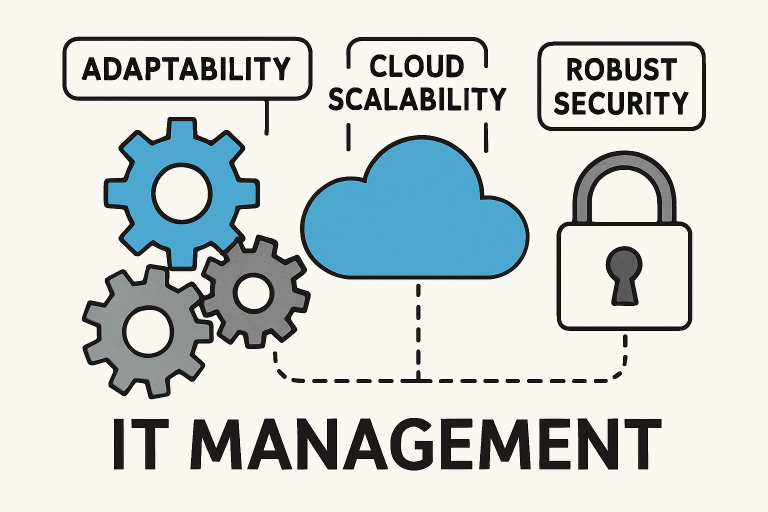
Future-proofing IT management requires coordinated strategies that prioritize adaptability, innovation, and resilience. By embedding AI, leveraging zero trust, adopting scalable solutions, and relying on proactive-managed services, organizations can navigate the challenges of digital evolution. These initiatives underpin robust IT environments that withstand disruption, enable transformation, and drive sustainable business success.
